Buying guide
Heated socks buying guide for men, women and skiers
How battery heated socks work, heat settings and run time, fit in boots, wellies and ski boots, who they suit, safety with numb feet, charging and washing.
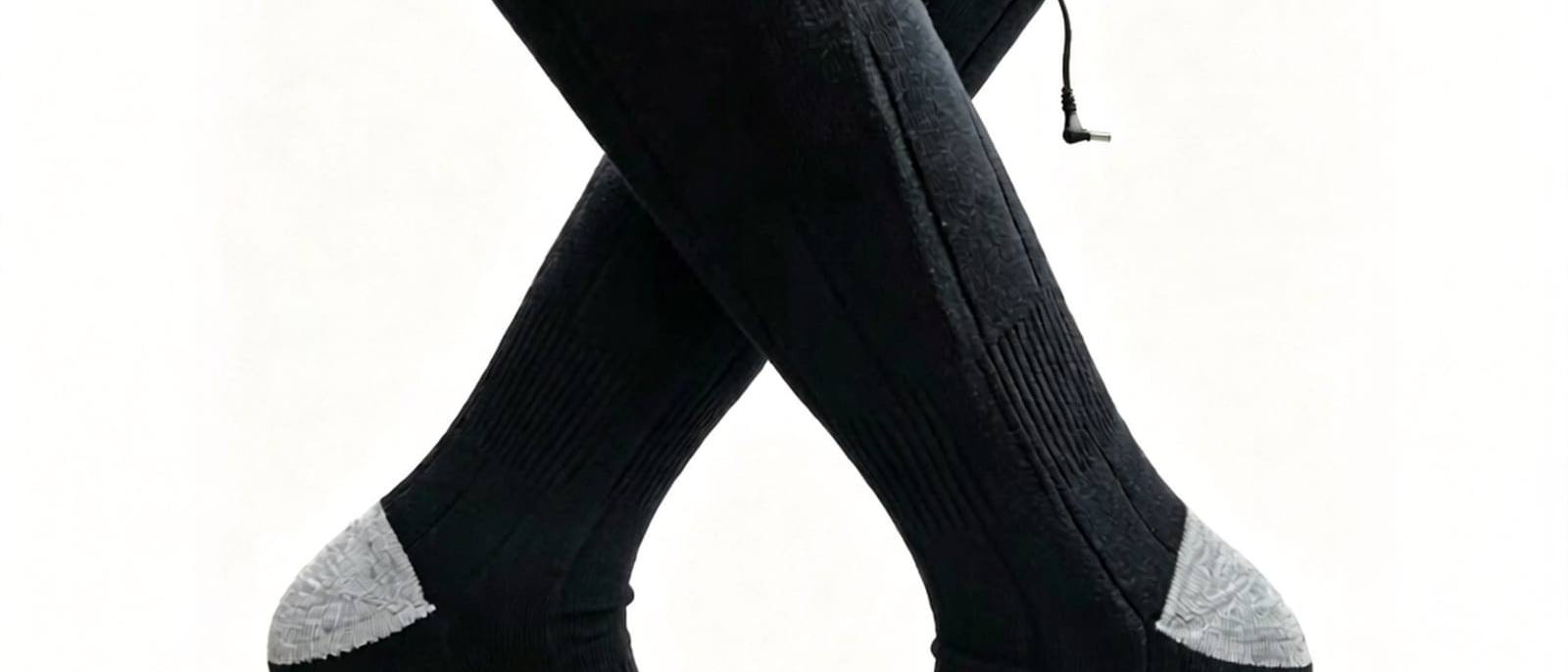
Heated socks are long socks with a fine heating wire in the foot, powered by a small rechargeable battery pack on each sock. They help most when you stand or sit still in the cold: on the touchline, on the riverbank or waiting for a ski lift. This guide explains how they work, how long the heat lasts, how they fit in boots and who should check with a doctor before using them.
How battery heated socks work
Electric heated socks and battery heated socks are usually the same thing: a thin wire knitted into the sock warms up when current from a battery runs through it.
On our heated socks with 4000 mAh battery packs, the wire sits in the foot and runs round the toes, where feet usually get cold first. A thin cable runs up the leg to a socket at the top of the sock. You plug a charged battery pack in there, tuck it into the top of the sock and switch it on. Nothing is wired through your boot, and there is no lead between the two feet: each sock has its own pack, so switch both on.
You set the heat on the pack itself. The supplier lists several heat levels, and three small lights on each pack show how much charge is left.
What to check before you buy
| What to check | Why it matters | Our heated socks |
|---|---|---|
| Where the heat sits | Toes get cold first | In the foot, round the toes |
| Battery | Decides how long the heat lasts | 2 x 4000 mAh rechargeable lithium packs |
| Run time | Does it cover your day out? | 3 to 6 hours per charge (supplier) |
| Charging time | Ready for the next morning? | About 3.5 hours (supplier) |
| Heat control | Lets you start low | Several levels, set on the pack |
| Length | Keeps the packs out of the boot | Knee length |
| Washing | Socks need washing often | Hand wash, batteries removed |
| Size | The wire has to reach your toes | One size, no shoe size range given |
Heat settings and run time
The supplier quotes 3 to 6 hours of heat from a full charge, depending on the setting. The highest setting uses the batteries fastest, and cold weather shortens the time further.
A few habits help the packs last:
- Charge fully before you go out. Three lights on each pack tell you where you stand.
- Switch on early and start low. Put the socks on and the heat on before your feet go cold, then turn it up only if you need to.
- Switch off when you move. On a walk to the ground or the lake your feet make their own heat. Save the battery for when you stop.
For a 90 minute match, one charge is plenty. For a full day's fishing or skiing, switching off on the move helps the packs last into the afternoon.
Who heated socks suit
Standing still is what makes feet cold. Heated socks are at their best for:
- football and rugby touchlines,
- fishing, shooting and bird watching,
- waiting for trains and buses,
- outdoor work where you stay in one spot,
- ski lifts and cold days on the slopes.
For long, brisk walks your feet make plenty of heat, and a good thick sock may be all you need. Our guide how to stay warm outdoors in a UK winter covers the rest of the kit, from layers to hats.
If your hands suffer as much as your feet, our rechargeable heated gloves with heated fingers have a built-in 3000 mAh battery, three heat levels and fold-back fingertips for your phone. The heat runs along the fingers and the back of the hand; the palm is not heated.
Fit in boots and wellies
A heated sock only works if the boot lets it. Squeezed toes stay cold whatever you wear, so:
- Leave a little room over the toes. If a boot is snug with a normal sock, it will be tight with a heated one.
- Wear them on their own, not over a second pair, so the wire sits close to your toes and the boot is not crammed.
- Pull them up fully. On our socks the packs sit at the top of the sock, below the knee, so they stay outside walking boots and wellies.
- Check tall wellies. Make sure the packs sit above the top of the boot and are not squashed inside it.
- Try them at home first with the boots you plan to wear.
Heated socks for skiing
Ski boots are fitted close, so socks matter. Advnture's boot-fitting advice is to try ski boots on with the socks you intend to wear on the mountain, and it warns that very thick ski socks can restrict circulation and leave your feet colder.
Know what you are buying. Our socks are a cotton, general-purpose heated sock, not a thin technical ski sock. Try them in your ski boots at home before the trip, and check that the boot cuff and buckles do not press on the battery packs at the top.
If you fly, put the battery packs in your cabin bag. UK Civil Aviation Authority guidance says spare lithium batteries must be carried in the cabin, not in the hold, and protected against short circuits. Check your airline's own rules too.
Safety: numb feet, sleep and wet socks
Reduced feeling in your feet
This is the most important point in this guide. The NHS says diabetes is the most common cause of peripheral neuropathy in the UK, and that symptoms include numbness and tingling in the feet. Diabetes UK warns that with neuropathy in your feet you may not notice them getting too hot until they start to burn. It advises extra care with hot water bottles, electric blankets and heaters, and says to still take your shoes and socks off each day in cold weather to check your feet.
So if you have diabetes, neuropathy or any loss of feeling in your feet, speak to your GP, diabetes team or podiatrist before you use heated socks. If they are happy for you to try them, use the lowest setting and check your skin afterwards.
Raynaud's and chilblains
We cannot tell you whether heated socks help any medical condition. The NHS self-care advice for Raynaud's includes wearing warm clothes in cold weather, especially on your hands and feet, and trying to avoid sudden changes in temperature. For chilblains, the NHS advises you to dry and slowly warm your skin after being in the cold, and not to put your feet on a radiator or under hot water to warm them up. If your toes often go numb or change colour, see a GP.
Sleep
Do not sleep in heated socks unless the instructions with your pair say they are made for it. Heated sock makers' instructions can include a warning not to wear them to sleep, because of the risk of burns.
Wet socks and damaged packs
Never plug the packs into socks that are still damp from washing. Essex County Fire and Rescue Service advises against using a battery that looks physically damaged and says batteries should not be crushed, punctured or put in water.
Charging the battery packs
The supplier quotes about 3.5 hours to charge the packs, and the charging cable is shown in the supplier's photos. The same Essex fire service advice applies to charging:
- charge on a flat, solid surface such as a kitchen worktop,
- do not leave batteries charging while you are asleep or away from home,
- unplug once the charge is complete,
- avoid storing, using or charging batteries at very high or very low temperatures.
In practice, put the packs on charge when you get in from a cold day, not last thing at night.
Washing heated socks
Socks need washing far more often than a jacket. Unplug and remove the packs, tuck the plug into the pocket at the top of the sock, and wash gently by hand. Do not wring them hard, and let them dry completely before you plug the batteries back in. Our guide how to wash heated clothing goes through it step by step.
The short version
Choose heated socks if you spend long spells standing or sitting still in the cold. Check that your boots have room over the toes, plan around 3 to 6 hours per charge, and talk to a health professional first if your feet have lost any feeling. See all our heated socks.
Frequently asked questions
How long do heated socks stay warm on one charge?
It depends on the socks, the heat level and the weather. The supplier of our knee-length heated socks quotes 3 to 6 hours from a full charge of the two 4000 mAh battery packs, and about 3.5 hours to charge them again. The highest level empties the packs fastest, so start on a low one.
Can you wear heated socks in wellies and walking boots?
Yes, as long as the boots leave a little room over the toes. On our socks the battery packs sit at the top of the sock, below the knee, so they stay outside walking boots and wellies. With tall wellies, check that the packs sit above the top of the boot and are not squashed inside it.
Are heated socks safe if I have diabetes?
Speak to your GP, diabetes team or podiatrist first if you have diabetes or any loss of feeling in your feet. Diabetes UK warns that with neuropathy you may not notice your feet getting too hot until they start to burn, and advises extra care with heat such as hot water bottles, electric blankets and heaters.
Can you sleep in heated socks?
We would not. Heated sock makers' instructions can include a warning not to wear them to sleep, because of the risk of burns, and nobody can keep an eye on their feet while asleep. Switch the socks off, unplug the packs and take them off before bed.
Are there separate heated socks for men and women?
Not from us. Our heated socks come in one size, and the supplier does not give a shoe size range. If you have very small or very large feet, email us before you order.